Runways with AI Catwalks: How Generative AI Is Rewriting Fashion’s Creative and Legal Architecture
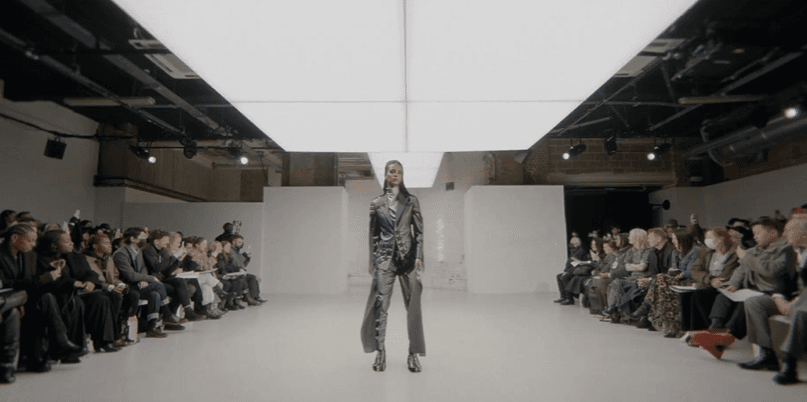
The year 1945 saw the first fashion catwalk at Paris Fashion Week, which popularised the runway as a symbol of cultural and societal change. Today, we live in a world where those very catwalks walk hand in hand with AI, driven by collaborations like NVIDIA and the Fashion Innovation Agency at NVIDIA GTC Paris, marking the beginning of a shift from fashion being a product and ecosystem of handmade, artistic creativity to a predictive system. This shift reflects the power of restructuring how fashion is conceptualised, validated, and monetised. The power of generative AI has reached a level of finesse where it can assist designers in simulating collections, casting, lighting, and even campaign environments, from picturesque walks in Rome, to Café de Flore in Paris to an elegant dinner in front of the Qutub, nothing seems limitless. It now saves costs on physical investments, collapsing what was once a sequential, high-risk pipeline into a simplified feedback loop driven by data. This goes beyond previously popularised digital fashion trends, including NFTs or virtual garments, which operated as parallel layers to the physical industry. With AI catwalks now at the core of production logic, they are becoming the dream dashboard for hyper-controlled, seamless transitions, perfected silhouettes, and atmospheres engineered to aesthetic precision, best suited to the creative direction. This very precision reveals how fashion is moving away from the unpredictability of material and human interpretation toward a system where showcased desirability is pre-tested and optimised. The subconscious appeal here is control. This blog has its eyes on this shift in the legal infrastructure we either have or do not have in place, and what is next for India if we see this used by our leading designers.

AI Fashion and Global Law, The US, UK and EU Legal Breakdown
One cannot say that the legal response to AI-driven systems, specifically fashion, is unified, and that is exactly why it becomes important to see the early red flags and green flags, what the law prioritises, what it does not, and what it should. The US approach remains fragmented as of today and is largely litigation-driven. Copyright law, under the US Copyright Act of 1976, requires that all eligible work be authored, in the first instance, by a human being, and the federal courts have very recently reinforced this position in Thaler v. Perlmutter, denying Dr. Stephen Thaler’s copyright claim over an AI-created image titled A Recent Entrance to Paradise. From this, one can say that had the first creation been of human skill, he could have gotten the claim, as held in the older precedent of Burrow-Giles Lithographic Co. v. Sarony, where a photograph was treated as an original work despite being taken through a machine, since it was the product of intellectual invention. Further, taking into consideration that Congress created the US Copyright Office under Article I, Section 8 of the Constitution to promote the progress of science and useful arts through exclusive rights, another important case to note is Allen v. Perlmutter, where even 600 prompts were not enough, and Jason Allen was denied copyright protection for Théâtre D’opéra Spatial. The position becomes clear, prompting does not equal ownership, no matter how detailed, original, or iterative. What becomes important for us is that hybrid AI works require precision, human contributions such as editing, selection, arrangement, or modification may be protectable, but only if properly identified and disclaimed. So there is an evident tension between how heavily designers may rely on generative systems and how much they still need to demonstrate their own discernment, skill, and involvement to legally attain ownership and commercialise their work. Another concern to be aware of is how ongoing lawsuits against AI companies for training models on copyrighted datasets without consent directly impact designers and stakeholders, when the very legality of these training systems is still in question. With such tensions looming overhead, a slight sense of clarity comes from the United Kingdom through the Copyright, Designs and Patents Act 1988, which recognises computer-generated works and allows authorship to be assigned to the person making the necessary arrangements for their creation under Section 9(3). On paper, this offers clarity for AI-assisted fashion design, but in practice, this still has to pass through layers of issues, training, data provenance, and potential infringement embedded within generative outputs. This becomes a cautionary layer that designers, creative directors, and all related stakeholders must actively examine. The European Union takes a more systemic approach. The copyright status of AI-generated fashion designs depends on how copyrighted content is used in the design process. As seen in Infopaq International A/S v. Danske Dagblades Forening, a work is protected only when it reflects the author’s own intellectual creation, particularly under Article 2(a) of Directive 2001/29. The case also clarified that even extracting small portions, such as 11 words during a data processing process, may not qualify as transient and could require consent from right holders, which becomes directly relevant for AI training systems. This brings the focus back to whether prompts, outputs, and final designs actually reflect human judgement, through selection, curation, refinement, and modification. At the same time, when we look at the data side under the General Data Protection Regulation and the emerging AI Act framework, these systems rely on automated decision-making processes that consume personal data, body metrics, and behavioural profiling to simulate demand and refine outputs. This brings in strict obligations around consent, purpose limitation, and data minimisation, effectively treating fashion brands using such systems as data-intensive entities rather than purely creative ones. The EU AI Act further introduces risk-based classification, transparency obligations, and accountability mechanisms for high-risk systems, signalling a move toward proactive governance rather than reactive enforcement. But the bottom line still remains, even in these advanced jurisdictions, gaps exist. If a designer based in the US creates AI-generated fashion and showcases or sells it first in London, how is jurisdiction decided, how does the data travel and remain protected across borders, and how are rights enforced when creation, training, and commercialisation are spread across multiple legal systems. These are questions that the current frameworks have not fully answered yet.

When It Will Be India’s Turn for AI Fashion
If I were to imagine India’s way of adapting to AI-driven fashion, I believe it will begin in the classrooms, at the hands of savvy students, and early within the world of startups, across the ecosystem of classrooms, ateliers, and design labs. Imagine the National Institute of Fashion Technology or the National Institute of Design integrating generative AI into their studios, and tomorrow you come across a creation where Banarasi weaves and Kanjeevaram motifs are found in an entire polo collection before even touching fabric. This may seem like a dream world for creative players, but the questions are bound to arise: who would own this output, simply the institution, or sometimes the student, or insidiously the dataset or the model provider as the originating source. Copyright ownership still remains under debate. Although there has been some movement, for instance, on November 5, 2025, when the Ministry of Electronics and Information Technology released its comprehensive AI guidelines, the tone leaned toward pro-innovation rather than restraint, but even with that, there remains clear uncertainty around copyright and patent granting. Section 2(d) of the Copyright Act, 1957 still requires that the author be a human. As Mohit Lahoty, Partner at ThinkLaw Advocates, has noted, the underlying principle remains that AI is a tool and not an autonomous agent replacing human authorship. Yet even with that position, it becomes necessary to consider that evolving AI and copyright jurisprudence is the need of the hour, with structured licensing for training datasets and liability frameworks that may have to be constructed on a case-by-case basis, as also pointed out by Senior Advocate N. S. Nappinai. When we turn to the Patents Act, 1970, the requirement that an inventor must be a natural person continues to hold, which further complicates the issue when multiple contributors are involved in training AI systems and generating outputs. If tomorrow Indian AI-first developers bring forward a software or application using base AI programs like ChatGPT or similar systems, ownership and inventorship would remain contested. Even at the development stage, it would not be in India’s best interest to operate without clarity. Instead, there is a stronger case for adopting frameworks aligned with global practices, centred on human authorship, clear AI disclosures, and traceability, ensuring that innovation does not outpace the legal structures required to sustain it.
Sources
Primary Reports, Articles, and Industry References NVIDIA, The Machine Muses: AI in Fashion, showcased at NVIDIA GTC Paris. Fashion Innovation Agency, London College of Fashion, University of the Arts London, project documentation and showcase materials. Aashir Ashfaq, “NVIDIA and Fashion Innovation Agency Collaboration Shows How AI Can Transform the Fashion Industry,” 2026. Legal Frameworks and Statutes US Copyright Act, 17 U.S.C. § 101 et seq. Copyright, Designs and Patents Act 1988. Directive 2001/29/EC (InfoSoc Directive). General Data Protection Regulation (Regulation (EU) 2016/679). Digital Personal Data Protection Act, 2023. Copyright Act, 1957. Patents Act, 1970. Key Cases and Judicial Precedents Thaler v. Perlmutter. Allen v. Perlmutter. Burrow-Giles Lithographic Co. v. Sarony. Infopaq International A/S v. Danske Dagblades Forening. Policy and Regulatory Developments Ministry of Electronics and Information Technology, AI Governance Guidelines, November 5, 2025. European Commission, Artificial Intelligence Act (Proposed Framework). Expert Commentary and Industry Insight Mohit Lahoty, Partner, ThinkLaw Advocates, commentary on AI as a tool in copyright law. N. S. Nappinai, Senior Advocate, Supreme Court of India, observations on AI liability and legislative gaps.

Vanshika Verma
Founder & Editor-in-Chief
Vanshika Verma founded Strategist’s Cut to explore the intersection of fashion, law, and capital. Drawing from research training and experience inside a fashion brand, her work examines how influence, markets, and cultural power are structured. With a background in legal analysis, market research, and digital media, she approaches publishing as a way to decode the systems shaping fashion, luxury, and business.